MODKOM

Modular components as Building Blocks for application-specific configurable space robots
Performance demonstration with three coupled base modules, the manipulator arm with coupled payload module, and the Rover Hunter SE (from AgileX Robotics) with the integrated EMI-MOD platform for mounting the manipulator arm and payload modules (Photo: DFKI)

Robotic systems will be of particular interest in the future for service operations on satellites or the exploration of other planets, as they are relatively inexpensive compared to manned spaceflight and at the same time flexible enough to respond to unforeseen events. However, the solutions developed and used to date have been highly mission-specific and are therefore highly specialized. In contrast, the definition of standards and modules should enable a rapid response to future exploration and service missions. The project described here focuses on the technological, mechatronic, and software development of modular functional units for reconfigurable and mobile robot systems. The performance of the modules developed in this project will be demonstrated through the implementation of a mobile manipulation system. To this end, existing functional units that are indispensable for exploration missions will be used within the project and further developed in such a way that the TRL is increased. Once a pool of functional units is available, robotic systems can be reconfigured according to the task at hand based on the modular system.

Duration: 01.07.2021 till 30.06.2025
Donee: German Research Center for Artificial Intelligence GmbH & University of Bremen
Sponsor: Federal Ministry for Economic Affairs and Climate Action
Grant number: Grant No. 50RA2107 (DFKI), 50RA2108 (Uni Bremen)
Partner:

Universität Bremen

Application Field: Space Robotics
Related Projects: iStruct
Intelligent Structures for Mobile Robots (05.2010- 08.2013)
Q-Rock
AI-based Qualification of Deliberative Behaviour for a Robotic Construction Kit (08.2018- 07.2021)
RIMRES
Reconfigurable Integrated Multi Robot Exploration System (09.2009- 12.2012)
TransTerrA
Semi-autonomous cooperative exploration of planetary surfaces including the installation of a logistic chain as well as consideration of the terrestrial applicability of individual aspects (05.2013- 12.2017)
FT-Utah
Field Trials Utah with the TransTerrA System (06.2016- 03.2017)
Related Robots: HunterSE
Z1-Arm
Z1-Arm with gripper
SherpaTT
Coyote III
CREX
Crater Explorer
Charlie
iStruct Demonstrator
Related Software: Rock
Robot Construction Kit
MARS
Machina Arte Robotum Simulans
NDLCom
Node Level Data Link Communication

Project details

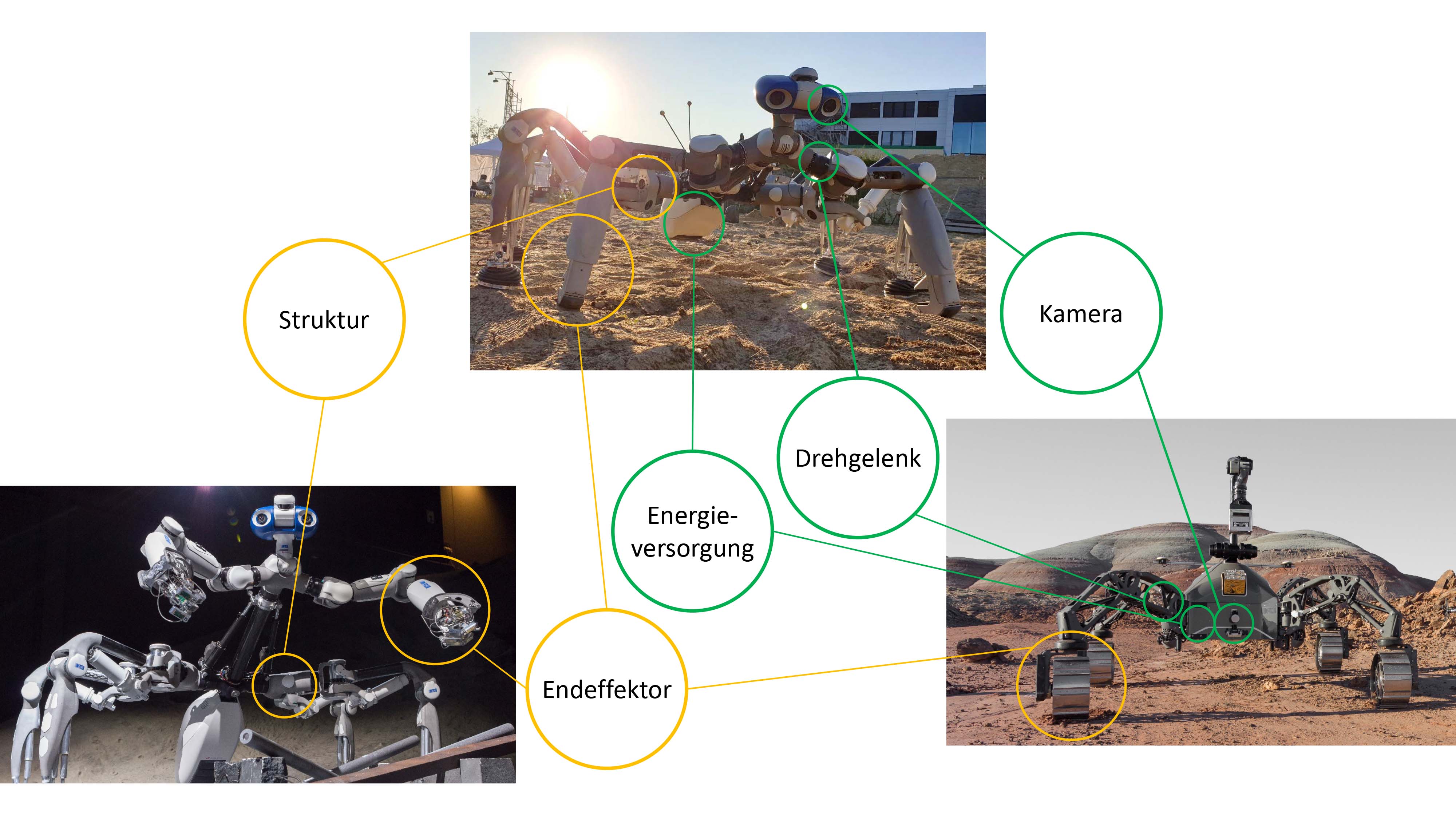
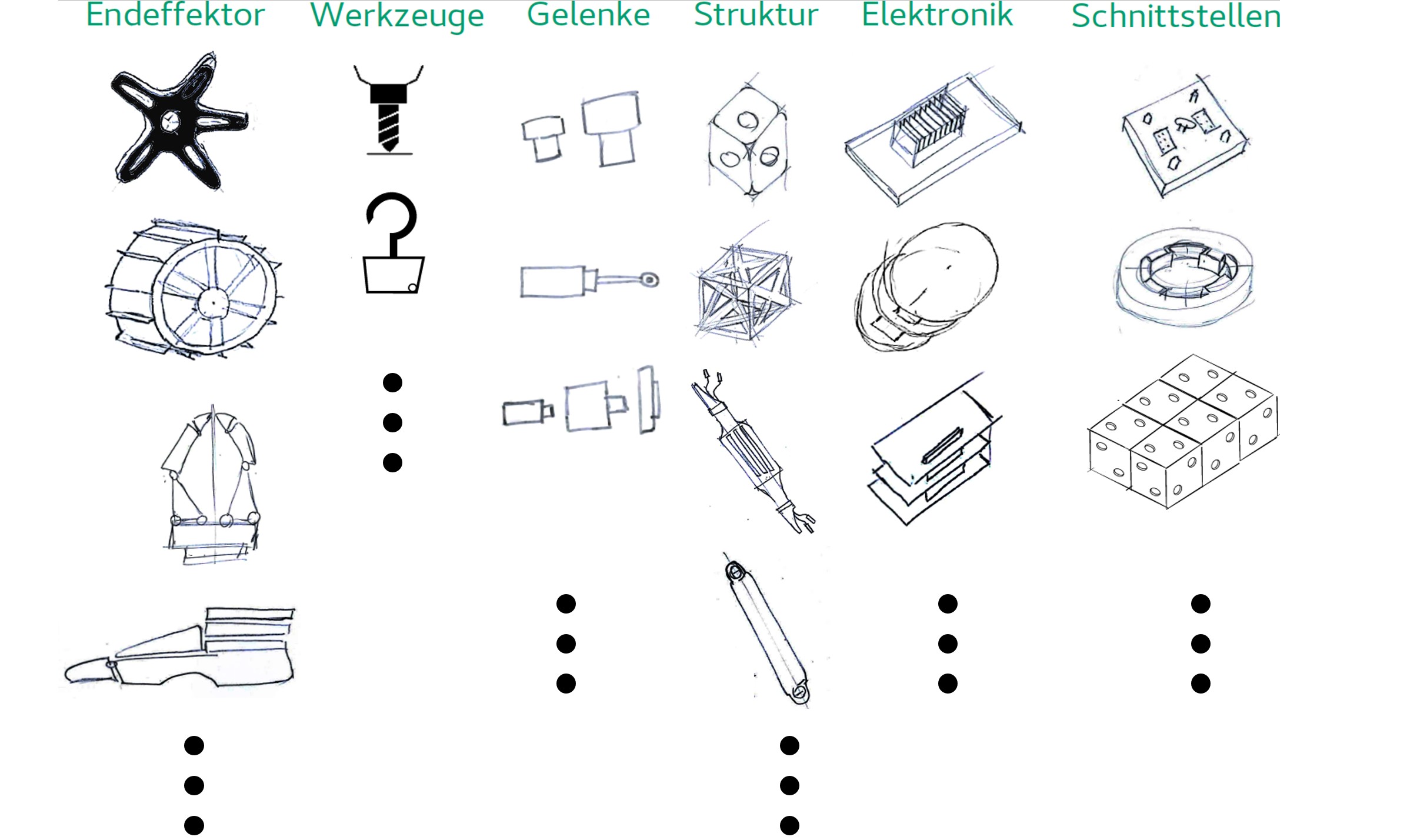
Exemplary representation of recurring functions in different robotic systems. (Photo: DFKI)
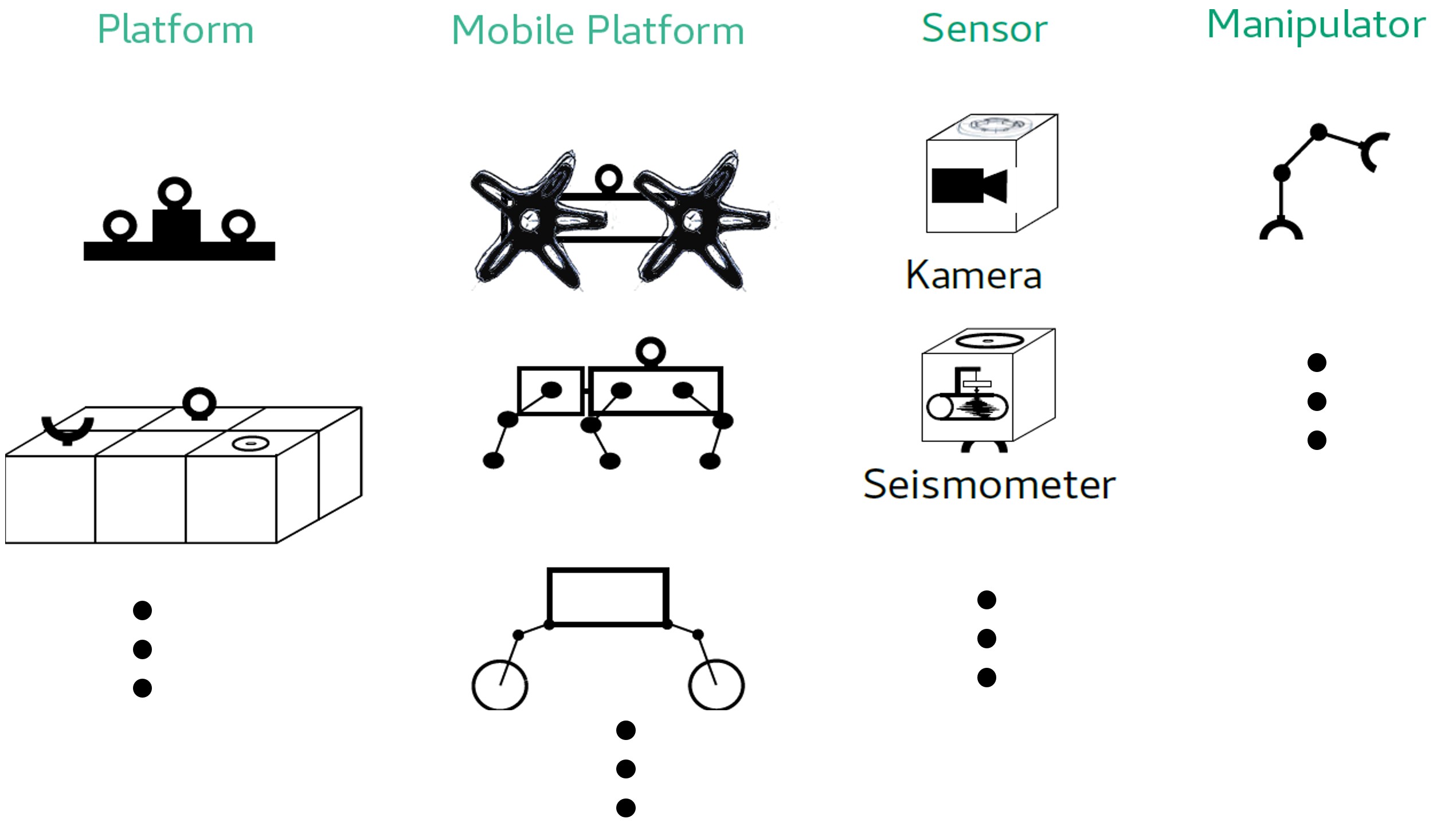
Overview of possible combinations of the modules and systems involved, connected via EMI-MOD (Photo: DFKI)

The MODKOM project presented here focused on the technological, mechatronic, and software development of modular functional units for reconfigurable robot systems. These are intended for use in various space missions. The establishment of a modular system, the possibility of subsequently adding or adapting system functions, the reusability of functional units, and the integration of existing technologies are intended to shorten development and qualification cycles. Artificial intelligence methods support the modular approach and enable the modules to act autonomously.

The top-level requirements of the modular system can be summarized as follows: reconfigurability, external compatibility, multi-purpose use, the possibility of further development and expansion, and a terrestrial environment for performance demonstration.

To meet these requirements, a corresponding modular system was developed within MODKOM. This comprises several modular components that were designed and built as part of the project. They can be combined according to mission-specific specifications with the aid of a software solution. The modular construction kit includes a 6-DoF manipulator arm, base modules with electronic slots, various payload modules (battery, camera, gas sensor), adapters for multifunctional interfaces, and a robot joint.

To ensure modularity, the DFKI's multifunctional interface (EMI-MOD) was further developed within MODKOM. It allows all systems, modules, and subsystems to be combined with each other in a Lego-like manner, provided they are equipped with EMI-MOD.

In addition, the construction kit contains third-party systems, such as the Rover Hunter SE from AgileX Robotics. This has been equipped with a platform developed by DFKI with integrated EMI-MODs. This allows it to accommodate systems that also have EMI-MOD, such as the payload modules or the manipulator arm. Another purchased component is the iSSI® from iBOSS GmbH, which is also a multifunctional interface. It has been demonstrated that systems with iSSI® can be connected to the modules developed by DFKI using a specially developed adapter. This confirms the flexibility of the modular concept and its great potential for future space missions.

With a view to space applications, a particular focus was placed on the development of a dynamic quasi-direct-drive robot joint. This was developed in an iterative process. First, prototypes for the motor and the associated motor electronics were designed and tested. Based on this, the final iteration, the DFKI-X2D joint, was created, which achieved Technology Readiness Level (TRL) 5 in qualification tests. This represents an important step toward practical application in space.

Beyond the original project goal, markerless visual servoing was successfully implemented. This represents an important milestone for software-specific solutions for the autonomous (re)configuration of modular subsystems that can be used during a mission via a multifunctional interface.

In addition, a software solution was developed that maps both hardware and software components of the modular system in the form of a catalog. These components can be combined according to mission-specific requirements. Missions can be modeled in advance using a simulation. As a result, suitable components available in the catalog are recommended. The catalog is expandable and can also be used for additional hardware and software components, including those from third-party providers, provided that compatible interfaces are available.

Finally, results from the MODKOM construction kit have already been applied in other projects. For example, the strawberry-picking rover SHIVAA and the rover Artemis2, developed for planetary applications, were built with modular structural components and electronic modules whose foundations were developed in MODKOM.

Report on the MODKOM project on ZDF heute

MODKOM: Vibration testing of the Z-axis of DFKI prototypes at ZARM

Video-Vorschaubild
By playing the video, you accept YouTube's privacy policy.

To test components for the loads of a rocket launch, they are subjected to vibration tests in advance. The video shows parts of the vibration tests for the prototypes of the robot joints with sinusoidal loads in the direction of the Z-axis. Based on the findings from these tests, the mechanical design was optimized and the final space variant of the DFKI-X2D was developed. (Video: Jonas Eisenmenger, DFKI)

Publications

2025

Development of Quasi-Direct Drive Motor for Walking Robots in Extraterrestrial Environments
Jonas Eisenmenger, Zhongqian Zhao, Frank Kirchner
In Proceedings of the 14th EASN International Conference on "Innovation in Aviation & Space towards sustainability today & tomorrow", 8.10.-11.10.2024, Thessaloniki, MDPI, series Engineering Proceedings, volume 90, number 1, Apr/2025.
Toward Sustainable Space Exploration: Designing an AI-Powered Modular Toolbox for Future Planetary Exploration
Wiebke Brinkmann, Moritz Schilling, Priyanka Chowdhury, Jonas Eisenmenger, Jonas Benz, Malte Langosz, Jieying Li, Erik Michelson, Mehmed Yüksel, Frank Kirchner
In Engineering Proceedings, MDPI, volume 90, number 26, pages 1-9, Mar/2025.

2024

Development strategies for multi-robot teams in context of planetary exploration
Wiebke Brinkmann, Leon Cedric Danter, Amrita Suresh, Mehmed Yüksel, Manuel Meder, Frank Kirchner
In 2024 International Conference on Space Robotics, (iSpaRo-2024), 24.6.-27.6.2024, Luxembourg, o. A., Jun/2024.
Enhanced multifunctional interface for reconfigurability of robotic teams in planetary applications
Mehmed Yüksel, Wiebke Brinkmann, Marko Jankovic, Hilmi Dogu Kücüker, Frank Kirchner
In 2024 IEEE International Conference on Robotics and Automation, (ICRA-2024), 13.5.-17.5.2024, Yokohama, o. A., May/2024.
Enhancing Development of Modular Application-Specific Configurable Space Robots
Henning Wiedemann, Moritz Schilling, Priyanka Chowdhury, Wiebke Brinkmann, Isabelle Kien, Jieying Li, Malte Langosz, Erik Michelson
In Journal of Physics: Conference Series, IOP Publishing, volume 2716 (2024) 012094, pages 1-8, Mar/2024.

2023

Multifunctional interconnect for future modular planetary robots
Wiebke Brinkmann, Mehmed Yüksel, Holger Sprengel, Sven Kroffke, Marko Jankovic, Roland U. Sonsalla
In 74th International Astronautical Congress 2023, (IAC-2023), 2.10.-6.10.2023, Baku, International Astronautical Federation (IAF), 100 Avenue de Suffren 75015 Paris, France, Oct/2023. International Astronautical Federation (IAF).
Context-attentive robot reconfiguration for collaborative human-machine space missions
Isabelle Kien, Manuel Meder, Proneet Kumar Sharma
In 13th EASN International Conference, 05.9.-09.9.2023, Salerno, Italy, IOP Journal of Physics, Sep/2023.
Toolbox of Modular Components to Demonstrate Applicatio-Specific Configurable Space Robots
Mehmed Yüksel, Wiebke Brinkmann, Jonas Eisenmenger, Henning Wiedemann, Isabelle Kien, Niklas Mulsow, Frank Kirchner
In 17th Symposium on Advanced Space Technologies in Robotics and Automation, (ASTRA-2023), 18.10.-20.10.2023, Leiden, ESA Publications Division-ESTEC, ESA-ESTEC, Keplerlaan 1 2201 AZ Noordwijk, The Netherlands, 2023. European Space Agency (ESA).

2022

Toolbox Design to Demonstrate Application-Specific Configurable Space Robots Using Modular Components
Roland Sonsalla, Henning Wiedemann, Wiebke Brinkmann, Priyanka Chowdhury, Malte Langosz, Marko Jankovic, Christopher Schulz, Tobias Stark, Niklas Alexander Mulsow, Daniel Pizzutilo, Leonard Maisch, Patrick Schöberl
In 73rd International Astronautical Congress 2022, (IAC-2022), 18.9.-22.9.2022, Paris, International Astronautical Federation (IAF), 100 Avenue de Suffren 75015 Paris, France, Sep/2022. International Astronautical Federation (IAF).
Towards Modular Components as Building Blocks for Application-Specific Configurable Space Robots
Roland Sonsalla, Wiebke Brinkmann, Henning Wiedemann, Malte Langosz, Priyanka Chowdhury, Christopher Schulz, Marko Jankovic, Tobias Stark, Moritz Schilling, Niklas Mulsow, Daniel Pizzutilo
In 16th Symposium on Advanced Space Technologies in Robotics and Automation, (ASTRA-2022), 01.6.-02.6.2022, Noordwijk, ESA Publications Division-ESTEC, ESA-ESTEC, Keplerlaan 1 2201 AZ Noordwijk, The Netherlands, May/2022. ESA Conference Bureau / ATPI Corporate Events.

Back to the list of projects
© DFKI GmbH
last updated 07.04.2026