LIMES
Learning Intelligent Motions for Kinematically Complex Robots for Exploration in Space

 Quelle: Marc Manz, DFKI GmbH
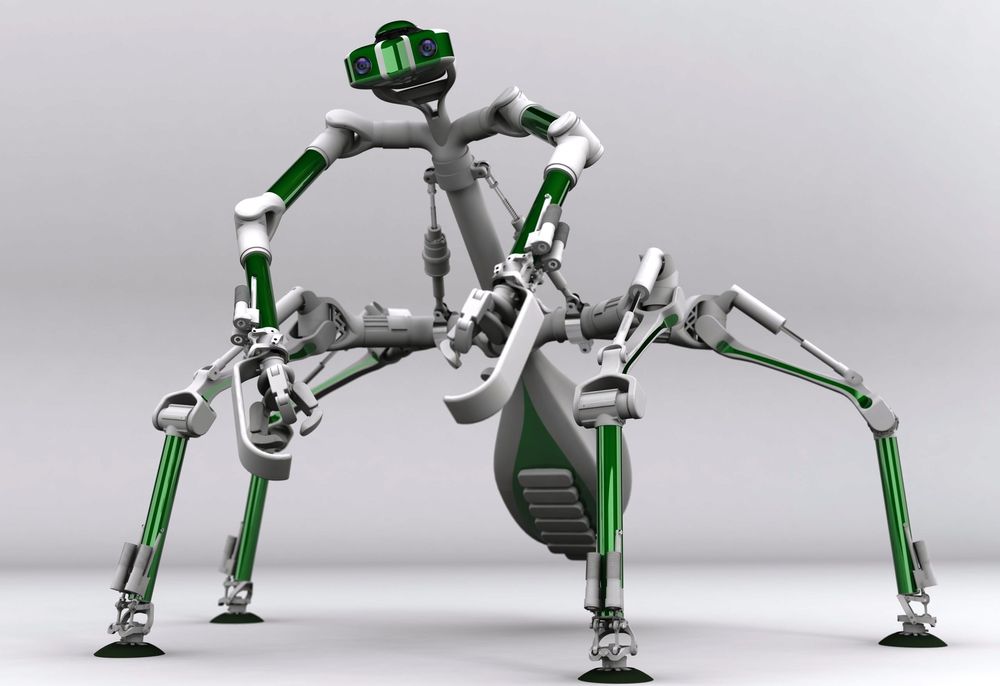
In the LIMES project, a highly mobile multi-legged walking robot with the ability to straighten up the upper body in order to use the front extremities as manipulation devices will be developed. In future extraterrestrial missions, such a system will allow taking soil samples from difficult-to-access regions or assembling and maintaining infrastructure on rough and unstructured surfaces of celestial bodies. Beside the mechatronic development of the robot, the project focuses on generating and optimizing different locomotion behaviors for traversing varying surface structures and subsoils with the aid of a simulation environment and machine learning methods.
Funding


- Funding note
- This project is funded by the Space Agency of the German Aerospace Center with federal funds of the Federal Ministry of Economics and Technology (BMWi) in accordance with the parliamentary resolution of the German Parliament, grant no. 50 RA 1218 (DFKI) und 50 RA 1219 (University of Bremen).
Project details
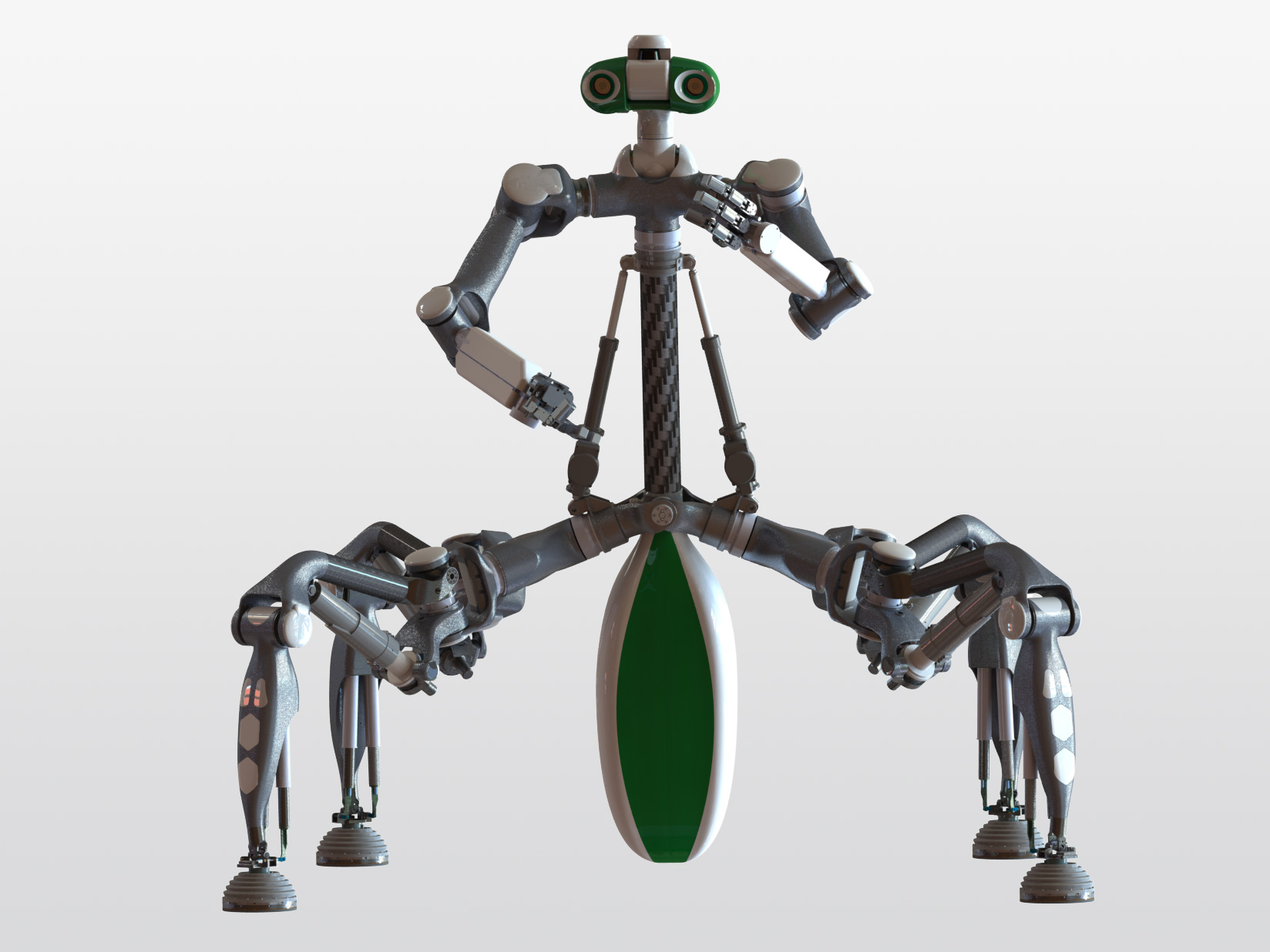 Foto: Marc Manz, DFKI GmbH
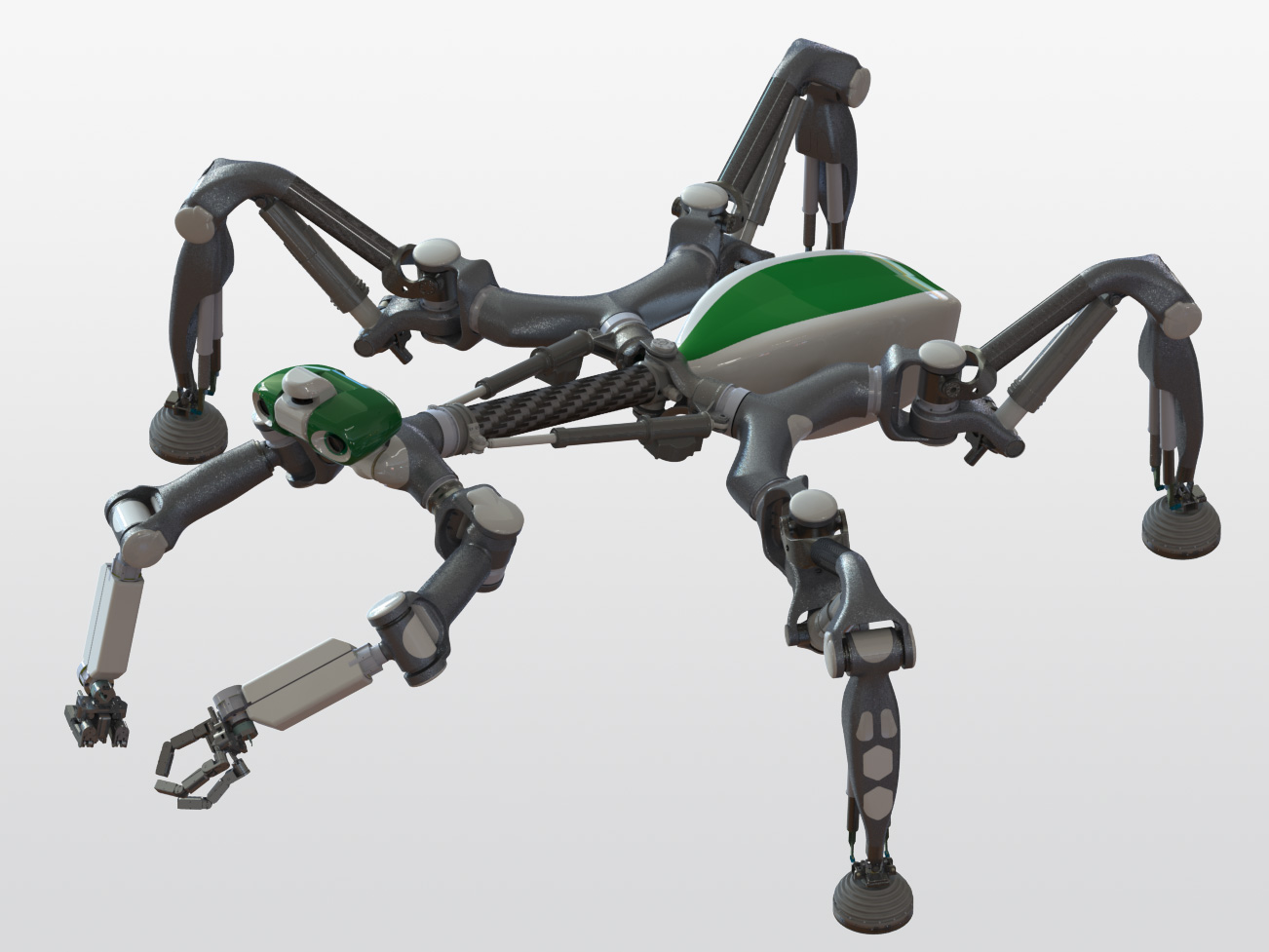 Foto: Marc Manz, DFKI GmbH
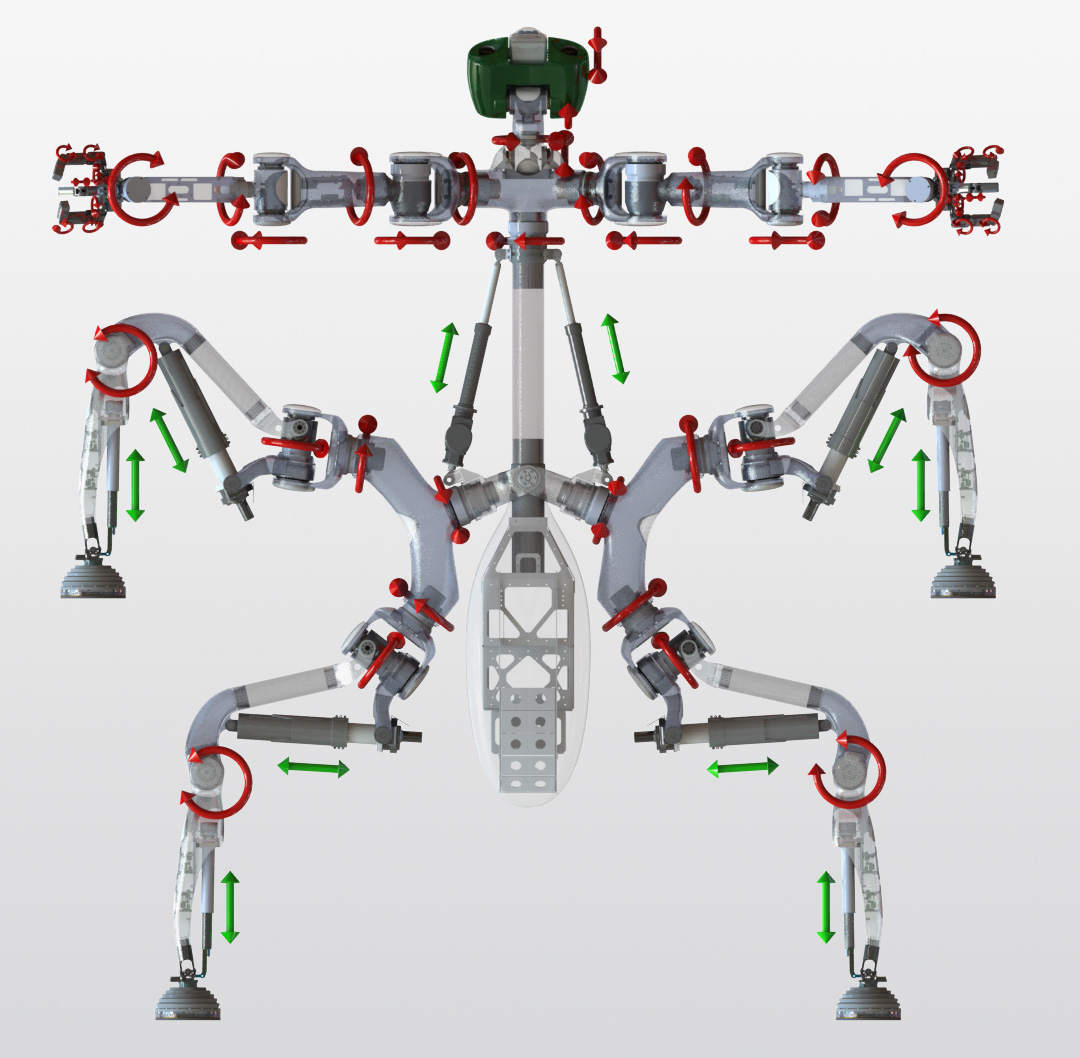 Foto: Marc Manz, DFKI GmbH
 Quelle: DFKI GmbH
Due to their large number of degrees of freedom which are distributed over several extremities, walking robots are able to perform a multitude of different walking patterns and to adapt their posture to the surface structure in order to maneuver securely and efficiently on rough surfaces. In addition, their manifold sensorial equipment makes a visual as well as a tactile perception of their environment possible, thus enabling them to gain information about the conditions of the substrate they are walking on. On the basis of this knowledge, the best locomotion behavior out of a set of previously optimized behaviors for varying situations can be selected.
The flexible locomotor system furthermore offers the possibility to use the legs for the manipulation of objects if these are equipped with the appropriate gripping devices. Here, too, a multi-modal sensory infrastructure is essential for coping with these tasks.
In the project LIMES a multi-legged robot will be developed which provides the mechatronical capabilities to manage the tasks described above. In parallel to the development of the hardware, precise simulation models for the subsystems of the robot will be developed in order to be able to simulate the behavior of the overall system with high accuracy.
Thereon, the virtual system can be utilized to generate and optimize different locomotion behaviors for various terrains with regard to diverse criteria (e.g. energy consumption, speed, etc.) by means of machine learning methods.
If the performance of a behavior has reached a high quality it can be transferred to the real system in order to proceed with the optimization.
Afterwards, the learned behaviors will be stored in a “behavior library” and can be selected and activated by the system for an optimal locomotion depending on its current situation.
In addition, the already learned behaviors can be used as a starting point for further learning procedures to generate new behaviors for other terrains or optimization criteria.
Moreover, the simulation allows to analyze the learned locomotion behaviors for the system under low gravity, as on Moon, and to optimize them for such conditions.
Videos
MANTIS: Multi-limbed walking robot for mobile manipulation in unstructured environments

The robot Mantis walking with different gaits and overcoming obstacles as well as performing different manipulation tasks.
LIMES/MANTIS

Animation of Mantis climbing in a crater to maintain infrastructure.
LIMES – Learning Intelligent Motions

Animation of Mantis performing EVA (Extra Vehicular Activity) activities outside a lunar human habitat.
Publications(19)
19 publications · BibTeX · approx. 10 KB
2021
- PhD Thesis
2020
-
Journal
Phobos: A tool for creating complex robot modelsJournal of Open Source Software, 5(45), 1326 · Jan 2020
-
Journal
BOLeRo: Behavior Optimization and Learning for RobotsInternational Journal of Advanced Robotic Systems, 17(3), n.n.-n.n. · 2020
2016
-
Conference
Development and Control of the Multi-Legged Robot MantisIn: Proceedings of ISR 2016: 47st International Symposium on Robotics, München, DE, 379-386 · Jun 2016
2015
-
Report
Experience-Based Adaptation of Locomotion Behaviors for Kinematically Complex Robots in Unstructured TerrainDFKI GmbH, Universität Bremen · Sep 2015
-
Report
An Experience-Based Interface for Abstracting the Motion Control of Kinematically Complex RobotsDFKI GmbH, Universität Bremen · Sep 2015
-
Report
Phobos: 3D Robot Modelling made easyIn: Proceedings of the RIC Project Day Workgroups Locomotion&Simulation, Bremen · Sep 2015
-
Report
Phobos: A Blender Plugin for Creating Robot Simulation ModelsIn: Proceedings of the RIC Project Day Workgroups Locomotion&Simulation, Bremen · Sep 2015
-
Conference
Experience-Based Adaptation of Locomotion Behaviors for Kinematically Complex Robots in Unstructured TerrainIn: In Proceedings of the 2015 IEEE/RSJ International Conference on Intelligent Robots and Systems (IROS 2015), Hamburg, DE, 4504-4511 · 2015
-
Conference
An Experience-Based Interface for Abstracting the Motion Control of Kinematically Complex RobotsIn: Proceedings of ASTRA 2015, Noordwijk, NL · 2015
-
Conference
Equipping industrial deep-sea manipulators with a sense of touchIn: Proceedings of the Oceans'15 MTS/IEEE Washington Conference & Exhibition, At Washington D.C., Washington D.C., US · 2015
2014
-
Conference
Introducing Particle Swarm Optimization Into a Genetic Algorithm to Evolve Robot ControllersIn: Proceedings of Genetic and Evolutionary Computation Conference, Vancouver, CA · Jul 2014
-
Report
How to use the Bus Pirate as a logic analyzerIn: Proceedings of the RIC Project Day Workgroups ‘Electronic Design’ and ‘Mechatronic Design’, Bremen, DE · Jul 2014
-
Conference
Towards Lifelong Learning of Optimal Control for Kinematically Complex RobotsIn: ICRA14 Workshop on Modelling, Estimation, Perception and Control of All Terrain Mobile Robots, Hong Kong, CN · Jun 2014
-
Journal
Integration of Fiber-Optic Sensor Arrays into a Multi-Modal Tactile Sensor Processing System for Robotic End-EffectorsSensors - Open Access Journal, 14 - Special Issue Tactile Sensors and Sensing Systems(4), 6854-6876 · Apr 2014
-
Conference
Extension of a plan-based component manager for real time adaptationIn: ISR/Robotik 2014; 41st International Symposium on Robotics; Proceedings of, Munich, DE, 1-6 · 2014
2013
-
Conference
Spaceclimber: A Six-Legged Robot For Extraterrestrial Surface Exploration In Unstructured And Steep TerrainIn: Proceedings of the Seventh International Workshop on Robotics for Risky Environment - Extreme Robotics, St. Petersburg, RU · Oct 2013
-
Conference
A Behavior-based Library for Locomotion Control of Kinematically Complex RobotsIn: Proceedings of the 16th International Conference on Climbing and Walking Robots, Sydney, AU · Jul 2013
-
Conference
MANTIS - A Robot With Advanced Locomotion And Manipulation AbilitiesIn: Proceedings of the 12th Symposium on Advanced Space Technologies in Robotics and Automation, Noordwijk, NL · May 2013